
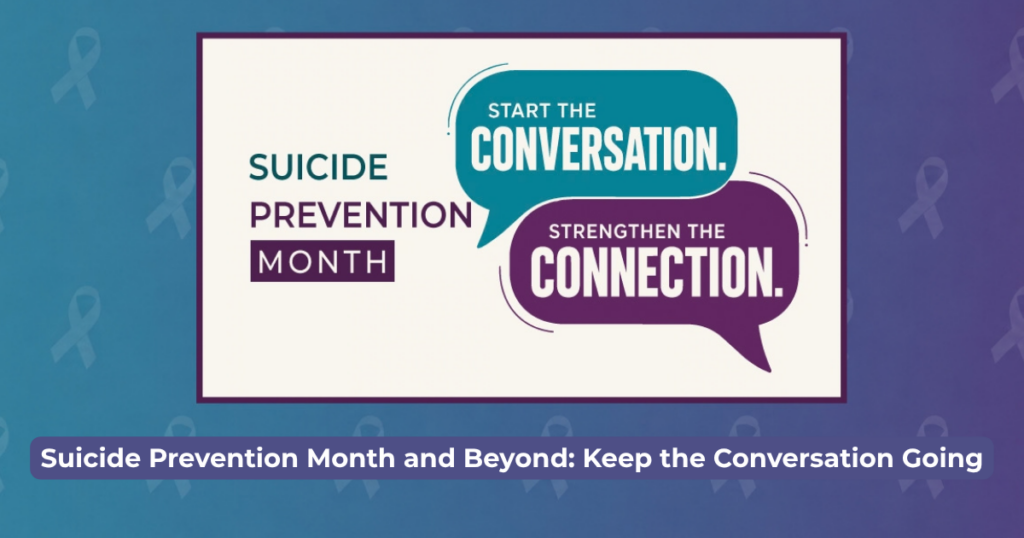
As September and Suicide Prevention Awareness Month come to a close, the reminders we’ve shared throughout the month remain important.
Every conversation can make room for care.
Check in with someone you know and love. Ask how they’re doing, make time for the answer and keep checking in. A conversation doesn’t have to be perfect to let someone know they matter.
Sometimes suicide prevention begins with something that simple.
Don’t Wait for a Crisis to Check In
When someone we know seems different, it can be difficult to know what to say. We may worry about saying the wrong thing or making someone uncomfortable.
But reaching out matters.
A simple “I’ve noticed you haven’t seemed like yourself lately. How are you doing?” can open the door. If you are concerned that someone may be thinking about suicide, it is okay to ask directly and listen without judgment.
You don’t need to have all the answers. Listen. Stay connected. Help the person reach additional support when needed.
Know Some of the Warning Signs
Warning signs can look different from person to person. Changes that may signal someone is struggling can include:
- Talking about suicide or expressing hopelessness
- Talking about feeling trapped, in unbearable pain or like a burden to others
- Withdrawing from family, friends or activities
- Significant changes in sleep or behavior
- Increased anxiety, agitation or reckless behavior
- Increased use of alcohol or drugs
- Extreme mood changes
Pay particular attention when these behaviors are new, increasing or follow a painful event, loss or significant life change.
Children and Teens May Show Distress Differently
Young people don’t always communicate emotional distress in the same ways adults do.
Parents, caregivers, educators, coaches and other trusted adults can watch for changes such as increasing hopelessness about the future, overwhelming emotional distress, withdrawal from friends or activities, changes in sleep, unusual anger or hostility, or increased agitation and irritability.
A child or teenager doesn’t have to explicitly say “I need help” for an adult to notice that something has changed.
Ask. Listen. Take concerns seriously. And keep checking in.
If You’re Struggling, You Can Reach Out, Too
Caring for one another also means recognizing when we need support.
You don’t have to know exactly what kind of help you need before you ask.
If you are experiencing emotional distress or are worried about someone else, call or text 988 to reach the Suicide & Crisis Lifeline. Support is available 24 hours a day, seven days a week.
You do not have to be suicidal to contact 988. The Lifeline is also available to people experiencing emotional distress and to family members, friends and others who are concerned about someone they care about.
If there is immediate, life-threatening danger, call 911.
When More Support May Be Needed
Sometimes outpatient support isn’t enough to safely manage an acute psychiatric crisis. Inpatient behavioral health care can provide a safe, structured environment for assessment, stabilization and treatment.
TaraVista Behavioral Health Center provides inpatient psychiatric care for children ages 5–12, adolescents ages 13–17 and adults. MiraVista Behavioral Health Center provides inpatient psychiatric care for adolescents and adults.
If you have questions about inpatient behavioral health care for yourself, a patient or someone you love, our Admissions teams are available to help you understand options and next steps.
TaraVista Admissions: 978-615-5252
MiraVista Admissions: 413-264-0819
You don’t have to know exactly what type of care is needed before reaching out.
If you have questions about inpatient behavioral health care for yourself or someone you love, The Vistas welcome your questions. You don’t have to know exactly what type of care is needed before reaching out.
Call Kim Lee, Chief of Creative Strategy and Development, at 413-264-3042 to ask questions and learn more.
Keep the Conversation Going
September may be ending. The conversations, the check-ins and the care continue.
Check in with someone you haven’t heard from lately. Make time for the answer. Reach out again tomorrow or next week. Save 988 in your phone and share it with someone you care about.
And remember that asking for help is a conversation, too.
Every conversation can make room for care.